
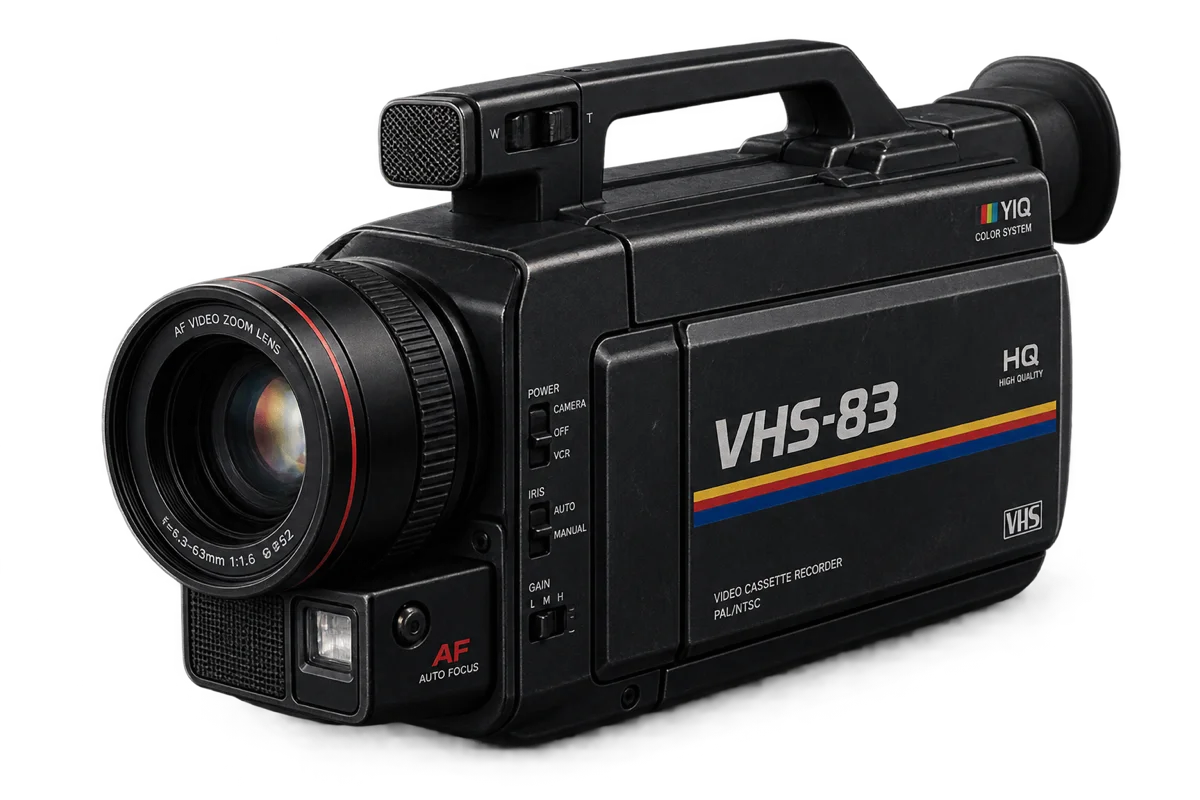
VHS-83VHS-C
Analog tape, 1993.
- Reference
- VHS-C consumer camcorder, early-to-mid 1990s (working alternates: GR-45, PV-90)
- Format
- SD 4:3
- Modes
- Photo · Video
- Video
- 30fps · 60s max clip
- Flash
- torch
- Pricing
- Paid in-app unlock
What it simulates
- RGB to FCC YIQ colour space conversion (real signal math, not a colour filter)
- Chroma channel bandlimit
- Luma smear with τ2.32-tap filter
- Preemphasis stage
- QAM demodulation producing cross-colour rainbow crawl on fine detail
- Dot crawl
- 5% composite noise (surfaces as GRAIN ruler at 0.05)
- Snow
- Head-switch tear band at the bottom of every frame
How it behaves at capture
- Live in the viewfinder — the full composite-signal chain renders before the shutter
- Fixed SD 4:3 framing — 480 vertical lines fall out of the low-res grid
- The digital-tape stage is disabled — the two systems must never stack
- 3-state torch (no flash burst)
- TAPE controls: SMEAR, RAINBOW, TRACKING
What VHS-83 is
VHS-83 is a VHS-C consumer camcorder simulation. Not a VHS filter — a signal-chain model. Afterhours ports the composite-video math directly from ntsc-rs v0.9.0 (MIT/Apache/ISC) and runs it in a single SkSL fragment pass on an SD 4:3 grid. Every artifact you see happens for the same reason a real VCR produces it: the signal chain.
The signal chain
Real composite video encodes colour by modulating chroma onto a subcarrier and mixing it with luma. The receiver demodulates. Along the way, everything you associate with VHS happens: the chroma bandlimit softens colour edges, the luma smear pulls detail sideways, the QAM demod produces cross-colour on fine repeating patterns (rainbow crawl on herringbone, dot crawl on sharp lines), and the head switch — the moment a rotating drum swaps to the next tape head — leaves a distinctive tear at the bottom of every frame.
VHS-83 does that math. RGB → FCC YIQ → chroma bandlimit → luma smear with a τ2.32-tap filter → preemphasis → cross-colour and dot crawl from the demod → 5% composite noise → snow → head-switch tear band.
Why "the two systems must never stack"
VHS artifacts and MiniDV artifacts come from completely different signal chains — analogue composite vs. digital tape. Stacking them on the same frame gives you a look that never existed in the real world. Afterhours' internal doc puts a rule on it: "the two systems must never stack." When VHS-83 renders, the digital-tape stage in the AFTERHOURS shader is zeroed out. You get VHS artifacts. You do not get VHS-plus-MiniDV artifacts.
That's the anti-pattern the whole vintage-camera category struggles with. It's called out directly in Why vintage camera apps often look fake — a guide we haven't written yet, but the thesis lives in VHS-83's implementation.
How to shoot with VHS-83
- Fine repeating patterns — herringbone, brick walls, thin stripes — light up the rainbow crawl. Great for detail-forward shots
- Motion drives dropout and head-switch behaviour; static scenes read cleaner than moving ones
- 4:3 framing is fixed; compose for the box
- The TAPE controls dial artifact intensity — turn SMEAR up for the low-fidelity look, down for a cleaner 1993 signal
See also NS-8 (Hi8 Handycam), HDV-2000 (MiniDV deck), and CRT-9 (playback fiction on a tube monitor).
VHS-83 status: built, on-device tuning in progress. Sample reel pending.
Frequently asked questions
Is VHS-83 a filter or a camera simulation?
A camera simulation. VHS-83 is a straight port of ntsc-rs v0.9.0 — the same composite-signal math a real VCR performs. RGB gets remapped to YIQ, chroma bandlimited, luma smeared, QAM demodulated. That's not overlaid noise; that's the actual signal chain.
Does VHS-83 stack VHS artifacts on top of MiniDV artifacts?
No — that would be dishonest, and Afterhours' internal docs explicitly forbid it. When VHS-83 renders, the digital-tape stage is disabled. The rule from the doc: "the two systems must never stack." A VHS filter that also renders MiniDV macroblocks isn't a VHS filter; it's an overlay pack.
What does the '83' in VHS-83 refer to?
The name is era-flavour, not a specific year. The camera targets the VHS-C consumer camcorder look of the early-to-mid 1990s. Working alternate names during development were GR-45 and PV-90, but VHS-83 stuck.
Is VHS-83 free?
No. VHS-83 is a paid in-app unlock. Free cameras on the AFTERHOURS shelf include NS-8, SNAP-27, and G8X MIII.
Can I turn off the head-switch tear?
The TAPE controls (SMEAR, RAINBOW, TRACKING) let you tune the intensity of each artifact family. The head-switch tear is part of the composite-signal pipeline — you can dial it down but not fully off, because it's what makes a VHS frame look like a VHS frame.
Published by Afterhours Camera. Reviewed . Corrections and questions: bricksandcanvas@gmail.com.